Enter the seven letters from your Spelling Bee hive and this solver lists every word that fits the puzzle's rules: at least four letters, the center letter included, and only letters from the hive, which may repeat. Words that use all seven letters are pangrams, and they're identified separately because they carry a seven-point bonus. The solver works for the Daily Spelling Bee Game as well as Unlimited or custom hives, since it solves whatever letters you give it. If you only want a nudge, try our spelling bee hints first and come back for the full list.
Using the spelling bee solver tool is simple. Enter the letters from your puzzle, run the search, and review the words that match the rules.
Start by entering the puzzle's center letter in the highlighted middle position. Because the center letter is mandatory, every word found by the solver will contain this letter.
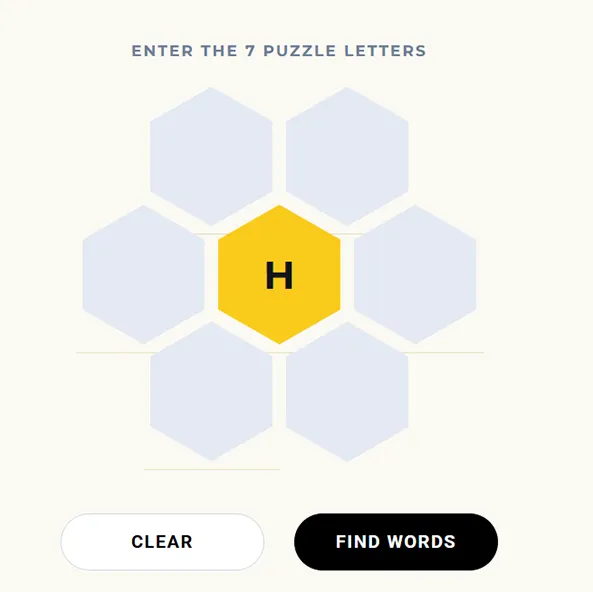
Next, enter the six remaining letters around the center. The order does not matter, so simply place each letter into one of the available outer positions.
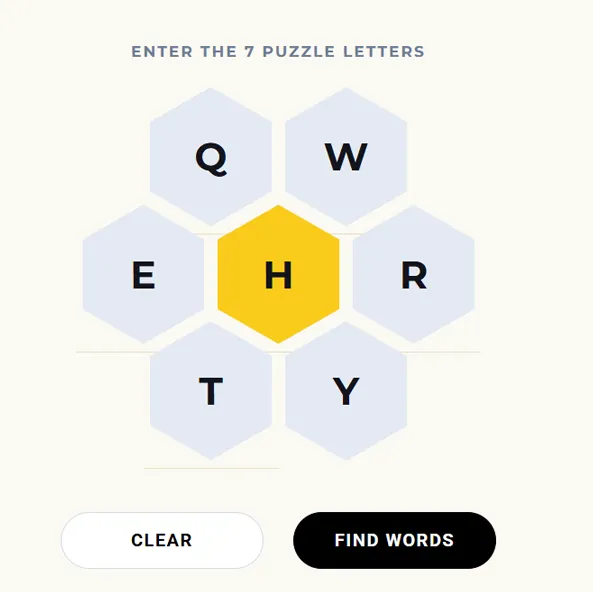
Select Find Words to start the search. The solver compares your seven-letter set against its word list and displays words that satisfy the puzzle rules. Results can be reviewed by word length, while pangrams can be identified separately for easier scoring.
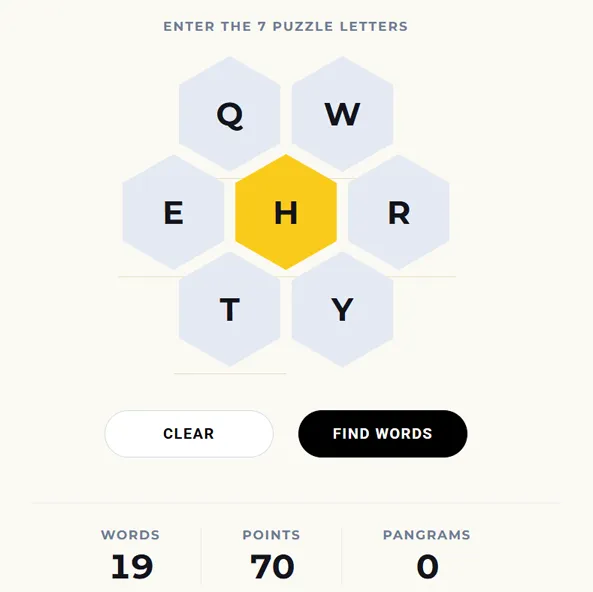
For this example, take a hive with P in the center and A, C, D, E, K, N around it. Here is how the rules apply to some candidate words.
| Word | Valid? | Why |
|---|---|---|
| KEEP | Yes | Uses K, E, E, P. Contains the center letter P, and E repeats |
| PEPPED | Yes | P appears three times, and repeats are allowed |
| PANCAKED | Yes, a pangram | Uses all seven letters: P, A, N, C, K, E, D |
| DEAD | No | Every letter is in the hive, but there is no P |
| PAINT | No | I and T are not in the hive |
| PAD | No | Only three letters |
Running these seven letters through this solver returns 62 words worth a maximum of 305 points, including two pangrams, KNEECAPPED and PANCAKED. Here is where the points come from:
| Word length | Words | Points each | Points |
|---|---|---|---|
| 4 letters | 19 | 1 | 19 |
| 5 letters | 12 | 5 | 60 |
| 6 letters | 18 | 6 | 108 |
| 7 letters | 6 | 7 | 42 |
| 8 letters | 4 | 8 | 32 |
| 10 letters | 3 | 10 | 30 |
| Pangram bonus | 2 pangrams | +7 each | 14 |
| Total | 62 | 305 |
Two things stand out. First, the 31 words with four or five letters are worth only 79 points between them. Second, Genius is commonly cited at about 70% of a puzzle's maximum, which would be roughly 214 points on this hive. You can't get there on short words alone, so the longer-length groups in your results are usually the better place to look.
The game's own list may be slightly smaller than a solver's, because it excludes some uncommon words. That gap is explained below.
The solver applies three checks to every word in its list:
A final pass flags any word that contains all seven letters as a pangram.
This is why an ordinary anagram tool is the wrong instrument. Anagram solvers typically treat letters as single-use tiles, so they would struggle to produce PEPPED from the hive above, which uses P three times. They also have no concept of a required center letter. A hive-specific solver treats your letters as an allowed alphabet instead.
The game uses its own curated list, while a solver draws on a broader dictionary. An uncommon word can therefore appear in your results and still be refused in the game. That is a difference between word lists, not a malfunction.
Our solver uses a custom word list that is reviewed and verified against Merriam-Webster. We update the list from time to time as words are reviewed and game behavior changes. Because the game's accepted vocabulary can differ from our solver's list, some words may occasionally be missing or may be shown even though the game rejects them. If the game accepts a word we're missing, or rejects one we show, let us know at [email protected].
| Word type | Score |
|---|---|
| 4-letter word | 1 point |
| Word with 5 or more letters | 1 point for each letter |
| Pangram | Normal word score + 7 bonus points |
Pangram. A word that uses every one of the seven letters at least once. In the example above, PANCAKED earns 8 + 7 = 15 points.
Perfect pangram. A pangram that uses each of the seven puzzle letters exactly once, making it exactly seven letters long. For example, VETOING is a perfect pangram because it uses all seven letters once and is worth 7 + 7 = 14 points. KNEECAPPED and PANCAKED are not perfect pangrams because they repeat letters.
Hive. The honeycomb of seven letters: one in the center, six around it.
Genius. A rank earned at 70% of the day's maximum points. The NYT Spelling Bee rank ladder is: Beginner (0%), Good Start (2%), Moving Up (5%), Good (8%), Solid (15%), Nice (25%), Great (40%), Amazing (50%), Genius (70%), and Queen Bee (100%). Because the maximum possible score changes from puzzle to puzzle, the number of points needed for each rank also changes.
Queen Bee. The top rank. It requires finding every accepted word in the puzzle.
There is no single right way to play. The best method depends on whether you want to build vocabulary, enjoy the challenge, or just find a missing answer.
| Approach | When It Works Best | Main Drawback |
|---|---|---|
| Solve without assistance | Building vocabulary and practicing word recognition | Can take longer and makes uncommon or repeated-letter words easier to overlook |
| Use the solver for hints | When you are stuck on one or two words and want to keep solving yourself | You need to avoid revealing more of the answer list than necessary |
| Use the complete solver results | Checking your progress, finding missed answers, or reviewing the entire puzzle | Seeing every answer immediately can reduce the challenge |
A good middle ground is to try the puzzle yourself first and reach for help only when you stall. Our spelling bee hints page is the place to start when you want a nudge rather than the whole list. When you're ready to see what you missed, come back to the solver above.
Want more practice? Spelling Bee Unlimited gives you a fresh hive anytime.
Last reviewed: October 2, 2026
Enter the seven letters from your hive, mark the center letter, and select Find Words. The solver returns every word that fits the rules, grouped by length.
No. Spelling Bee is a New York Times game, and this site is independent. The solver applies the game's letter rules to its own word list, so its results can differ slightly from what the game accepts.
That's up to you. Many players try the puzzle first and use a solver afterward to find missed words or check a stubborn one. You can also reveal only a little at a time and keep solving the rest yourself.
Solvers can draw on a broader dictionary than the game. The game's curated list excludes categories such as proper nouns, hyphenated words, offensive terms and some obscure entries, so a rejected word can simply be a word-list mismatch rather than a problem with the solver.
The game's list is curated by its editors, and no two dictionaries agree exactly. A less common or newer word can be accepted in the game but absent from a solver's list. If you find one, send it to [email protected] so we can review it.
Yes. Any of the seven letters, including the center letter, can appear more than once. Every word must still contain the center letter, use only hive letters, and have at least four letters.
Every valid word must include it. The same seven letters with a different center letter make a different puzzle with a different answer list, so the solver can't give correct results without knowing which letter is in the middle.
An anagram solver typically treats each letter as a single-use tile. A Spelling Bee solver lets letters repeat (PEPPED uses P three times), requires the center letter, and enforces the four-letter minimum.
The game doesn't accept proper nouns, brands, abbreviations, hyphenated words or words with apostrophes. If one ever appears in a solver's results because its dictionary includes it, expect the game to reject it.
Yes. The solver works from the letters you enter, not from a date, so it handles past puzzles and any custom seven-letter set you want to test.
Genius is commonly cited at about 70% of a puzzle's maximum points, but the game sets the exact threshold. Four-letter words are worth 1 point each, while longer words earn 1 point per letter, so the longer words in your results are usually the fastest way to get there.
The solver can help you find many possible words, but Queen Bee requires every word accepted by the game. Because the solver's word list can differ from the game's curated list, compare the results with the game and skip words that it rejects.